These fees are non-refundable, even if the application is withdrawn or denied. For families applying for multiple members at once, costs add up quickly. Budget accordingly.
Processing times for family reunification
Processing times vary depending on the Directorate's workload and whether the application is complete.
For first-time residence permits, the Directorate states that processing can take up to 8–10 months. In practice, well-prepared applications with complete documentation tend to move faster. Renewals are typically processed within three months.
The most common reason for delays is missing or improperly formatted documentation. If the Directorate needs to request additional information, the clock effectively resets. Submit everything correctly the first time.
The Directorate does not expedite family reunification applications based on urgency alone. Plan well ahead of your intended move date.
Marriage vs. cohabitation: what the difference means
 Iceland recognises both marriage and registered cohabitation for family reunification purposes. In practice, however, married couples have a smoother path.
Married spouses benefit from the legal maintenance obligation under Icelandic law. This means only one spouse needs to demonstrate sufficient income for both. Married applicants also do not need to prove that the relationship has lasted a specific duration (though the Directorate may still investigate marriages of convenience).
Cohabiting partners must each demonstrate independent financial means. They must also prove that the cohabitation has lasted at least one year, using documents such as shared rental agreements, bank statements, utility bills, or a certificate of registered cohabitation. This documentation burden is heavier than for married couples.
If the Directorate has reason to suspect a marriage or cohabitation of convenience (one entered solely to obtain a residence permit), both parties may be called in for separate interviews. A union of convenience does not grant the right to a residence permit and is a criminal offence under Icelandic law.
Right to work after approval
Whether you can work in Iceland after receiving a family reunification permit depends on your sponsor's permit type.
Spouses of Icelandic citizens can work freely in Iceland without a separate work permit.
Spouses of expert-knowledge permit holders gained the right to work without a work permit under the 2023 amendments to the Foreign Nationals Act.
Spouses of other permit holders (general work permits, student permits, shortage-of-labour permits) must apply for a separate work permit through the Vinnumálastofnun (Directorate of Labour). This requires finding a job, signing an employment contract, and having the application approved. The application can be submitted after the residence permit is granted; it does not need to accompany the initial family reunification application.
For details on finding employment, see our guide to finding a job in Iceland.
Bringing children to Iceland
Children under 18 can be granted a residence permit to join a parent who holds a qualifying permit in Iceland. The key requirements:
The child must be in the custody of the sponsoring parent.
If custody is shared, the non-sponsoring parent must give written consent.
The child must be under 18 when the application is submitted.
A person with custody who is not the biological parent must have legally adopted the child. The adoption must comply with Icelandic law, and an individual living in Iceland who intends to adopt from abroad must obtain prior consent from the district commissioner.
Children under 18 who are provided for by a parent or legal guardian in Iceland do not need to demonstrate independent financial means.
Since 2023, children born in Iceland can receive a residence permit even if their parents hold permit types that do not normally carry family reunification rights. This was a significant expansion of the rules.
If you are moving with young children, our guides to daycare in Iceland and the Icelandic school system cover what to expect after arrival.
Parents aged 67 or older who are financially dependent on their adult child in Iceland can apply for a family reunification permit. The sponsoring child must meet the standard income requirement for themselves, plus an additional 123,786 ISK per month (50% of the individual minimum, as of February 2025) for the dependent parent.
The parent must also hold health insurance valid in Iceland with a minimum coverage of 2,000,000 ISK. This category is narrower than spouse or child reunification and is assessed more strictly by the Directorate.
If the relationship ends
A family reunification permit is tied to the relationship that justified it. If a marriage or cohabitation ends, the permit holder's right to stay in Iceland is affected.
In some cases, a permit on grounds of "special ties to Iceland" (sérstök tengsl) can be granted if the applicant can show that social or cultural circumstances would make it difficult to return to their home country. The Directorate assesses each case individually, considering the length of the relationship, the applicant's ties to Iceland, and whether returning home would cause serious hardship.
If the relationship ended because of domestic violence or abuse, the applicant can apply for a special ties permit. The violence or abuse must have been reported to the police or child protection authorities, or other documentation must be presented. The Directorate applies a lower standard of proof in these cases to avoid situations where an applicant feels compelled to remain in an abusive relationship to keep their permit.
If a spouse dies, a special ties permit may also be granted, provided the applicant continues to meet the income requirement and other conditions.
Path to permanent residency and citizenship
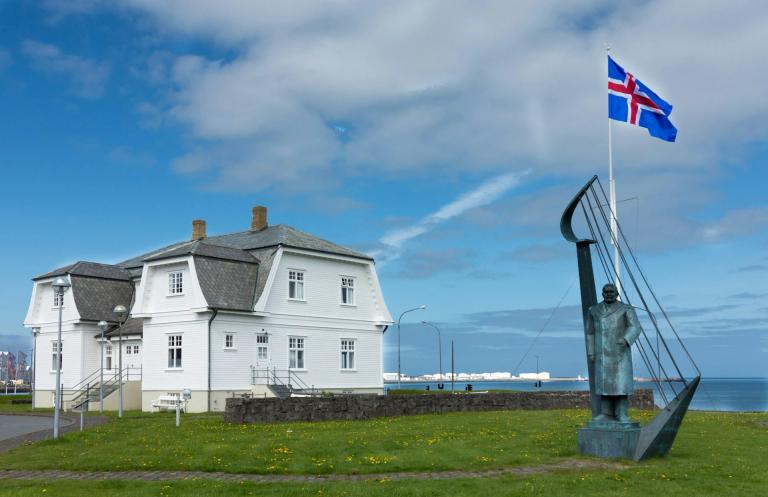 A family reunification permit can serve as a stepping stone toward permanent residency and eventually Icelandic citizenship.
Permanent residency requires four years of continuous lawful residence in Iceland on a permit that qualifies as a basis for permanent residence. For spouses of Icelandic citizens, the requirement is three years. Applicants must also demonstrate Icelandic language knowledge (at least 150 hours of coursework with 85% attendance, or a passed language assessment test), secure income, and no more than 90 days spent abroad per year.
Citizenship requires seven years of continuous residence for most applicants. Married spouses of Icelandic citizens can apply after four years of residence since the marriage. Cohabiting partners of Icelandic citizens can apply after five years since the registration of cohabitation. In both cases, the Icelandic partner must have held citizenship for at least five years. Our citizenship guide covers the full requirements and timeline.
Young people who arrived in Iceland on family reunification permits and have resided here for four or more years while studying or working can also apply for permanent residency once they turn 18.
EEA citizens: a different process
Everything above applies primarily to non-EEA nationals. If the family member moving to Iceland is an EEA/EFTA citizen (from an EU country, Norway, Liechtenstein, or Switzerland), the process is different and simpler.
EEA citizens have the right to live and work in Iceland. They do not need a residence permit. Instead, they register their domicile with Þjóðskrá Íslands (Registers Iceland) within three months of arrival. Non-EEA family members of EEA citizens may be eligible for a residence card rather than a full residence permit, under separate EEA rules.
For more on the EEA path, see our guide to moving to Iceland from the EU/EEA.
Practical tips
Start document gathering early. Criminal record certificates, apostille certifications, and translated documents can each take weeks to obtain. Start at least two to three months before you plan to submit.
Book temporary housing. If the family member is arriving while the application is still being processed (possible for visa-exempt nationals), arrange temporary accommodation. Our guide to finding a rental apartment covers the housing search process.
Budget realistically. Between application fees (110,000 ISK per adult), health insurance, document authentication, translations, and potential travel costs, the upfront expense of family reunification can reach several hundred thousand ISK. Factor in the cost of living in Iceland when planning your finances.
Get your kennitala promptly. Once the family member arrives and their domicile is registered, applying for a kennitala (Iceland's national ID number) should be an immediate priority. It is required for banking, healthcare registration, employment, and most interactions with government services.
Use our first 30 days checklist to stay on track with the practical steps after arrival.
Frequently asked questions
How long does family reunification take in Iceland?
First-time applications can take up to 8–10 months, though well-prepared applications with complete documentation are often processed faster. Renewals are typically handled within three months. The most common cause of delays is missing or incorrectly formatted paperwork.
Can I work in Iceland on a family reunification permit?
It depends on your sponsor's permit type. Spouses of Icelandic citizens and expert-knowledge permit holders can work freely. Spouses of other permit holders must apply for a separate work permit through the Directorate of Labour after finding employment and signing a contract.
What is the income requirement for family reunification in Iceland?
The sponsor must demonstrate pre-tax income of at least 247,572 ISK per month for an individual, or 396,115 ISK per month for a married couple (as of February 2025). These figures are adjusted each February. Social assistance payments do not count.
Can my unmarried partner apply for family reunification?
Yes. Iceland recognises cohabiting partners for family reunification, provided the cohabitation has lasted at least one year and can be documented. Cohabiting partners must each demonstrate independent financial means, unlike married spouses where one partner can cover both.
What happens to my permit if we divorce?
Your family reunification permit is tied to the relationship. If it ends, you may be able to apply for a permit on grounds of special ties to Iceland, particularly if you have strong connections to the country or if the relationship ended due to domestic violence. The Directorate assesses each case individually.
Can I bring my parents to Iceland?
Only parents aged 67 or older who are financially dependent on their adult child in Iceland are eligible for family reunification. Parents under 67, siblings, and extended family members are not eligible under current Icelandic law.
Last updated: March 2026